The Challenge
Individualized tutoring is proven to be one of the best ways to help struggling students succeed academically. But it's hard to say exactly what makes a tutoring session effective. The signals are often buried in nuanced, back-and-forth conversations that vary widely across students, subjects, and teaching styles.
Better ways of identifying effective tutoring could inform how we train educators, guide real-time support, and expand access to high-quality tutoring through AI-powered tools. They could also help with student knowledge tracing: keeping track of what a student understands from the conversation alone, without taking time for costly testing.
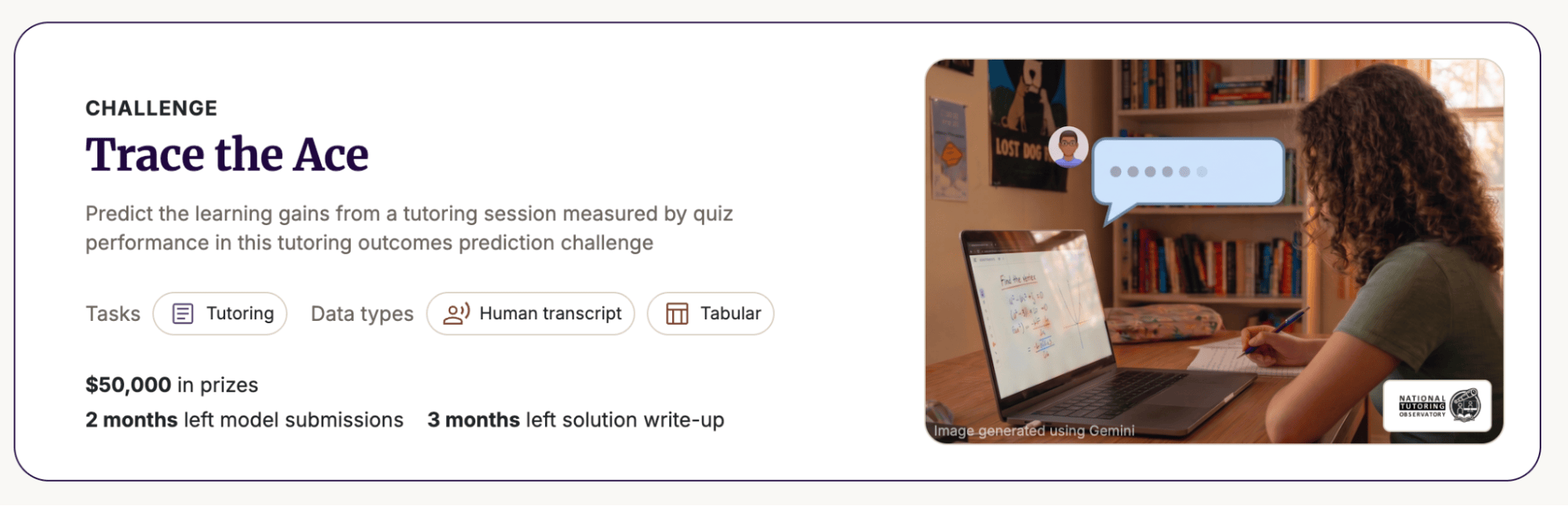
The goal of the Trace the Ace Challenge was to predict, from the transcript of a tutoring session, whether the student would answer the next question on the same topic correctly.
The data were real student–tutor conversations from online tutoring providers. Participants packaged their models and code for execution in the cloud, and predictions were scored with log loss, which rewards probabilities that are both accurate and honest about their uncertainty (lower is better).
Prizes weren't awarded on leaderboard rank alone. A key goal of the challenge was to find generalizable insights about tutoring and knowledge tracing. The top 15 teams on the final leaderboard were invited to submit a write-up of their findings, and judges chose overall winners based on relevance (35%), generalizability (35%), communication (15%), and rigor (15%).
Results
Trace the Ace was the first competition on the K-12 AI Infrastructure Platform, and drew a large field. 1,150 participants joined, placing it in the top 15% of DrivenData competitions since 2023. 560 active participants made 7,386 submissions.
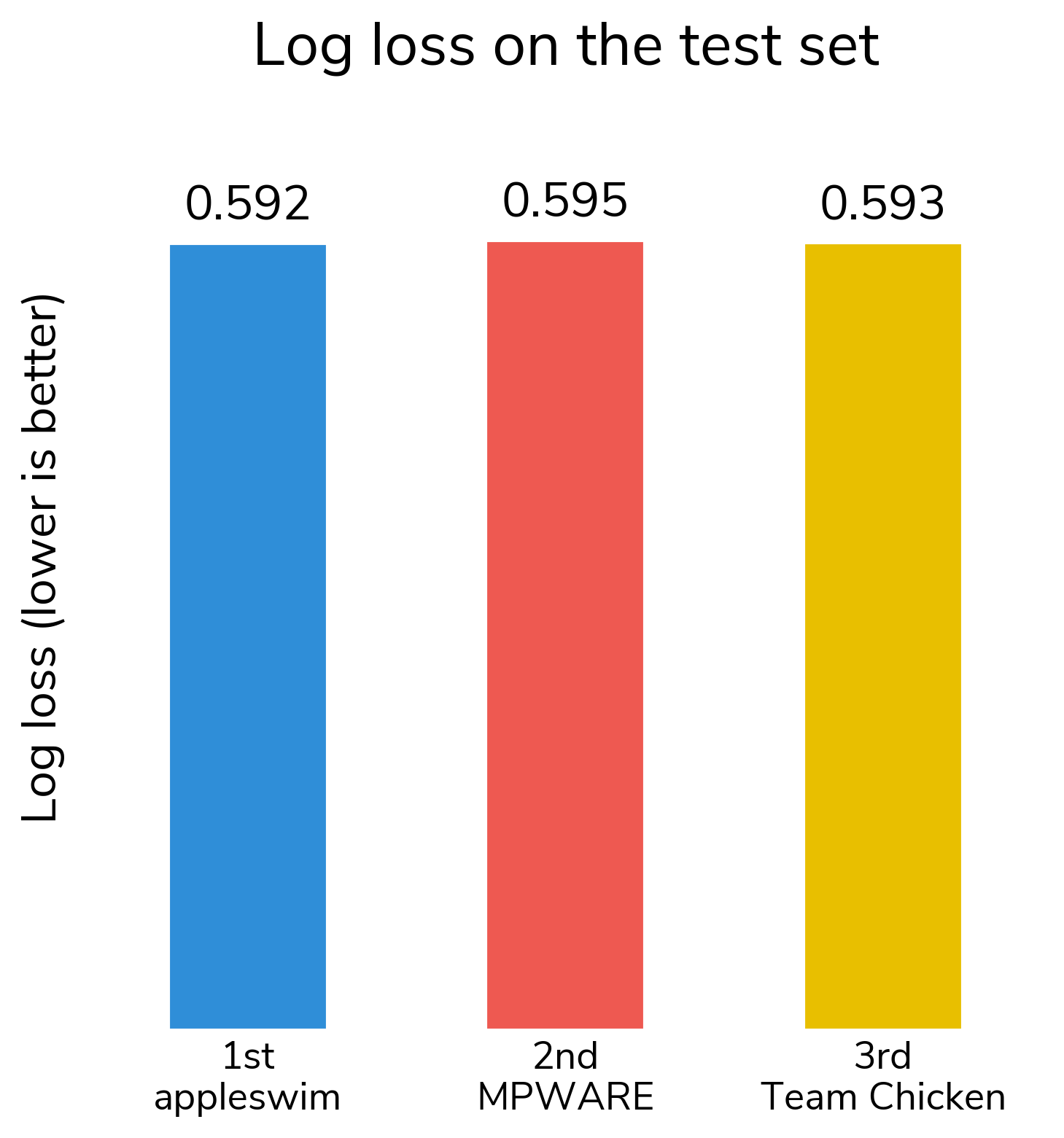
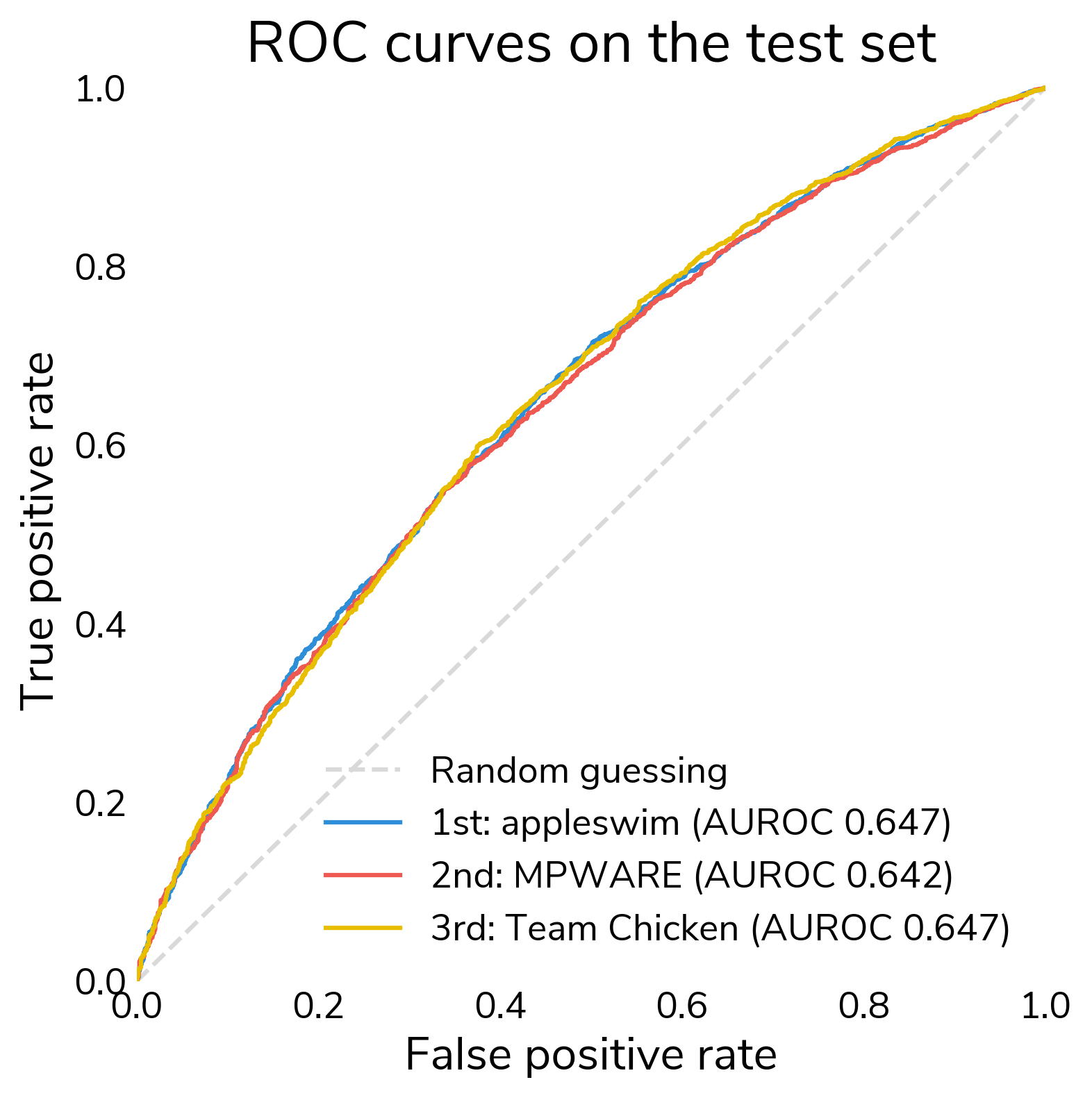
This was a challenging task—and an extremely close contest between top submissions! The top 30 participants all achieved a log loss between 0.59 and 0.60.
Key Takeaways from Winning Approaches
All three winning submissions took a similar approach: pairing a fine-tuned Qwen language model with a simpler model built on interpretable features describing student and tutor behavior.
All of the winners converged on Qwen as the best open-weight LLM for this task. Each winner gave a Qwen model the learning objective and most of the transcript, then asked it a true-or-false question: will this student get the next question right? Qwen is strong at math for its size, is free to fine-tune, and comes in sizes small enough to nicely balance compute cost and performance.
Domain knowledge and hand-crafted features still mattered in the age of LLMs. Every winner paired the language model with a simpler, more interpretable model (XGBoost, LightGBM, or logistic regression) built on features they designed to describe student and tutor behavior. The combination beat the language model alone. appleswim and MPWARE described what tutors did, such as asking questions, giving hints, correcting mistakes, or offering praise, alongside how students responded, such as showing confusion or correcting themselves.
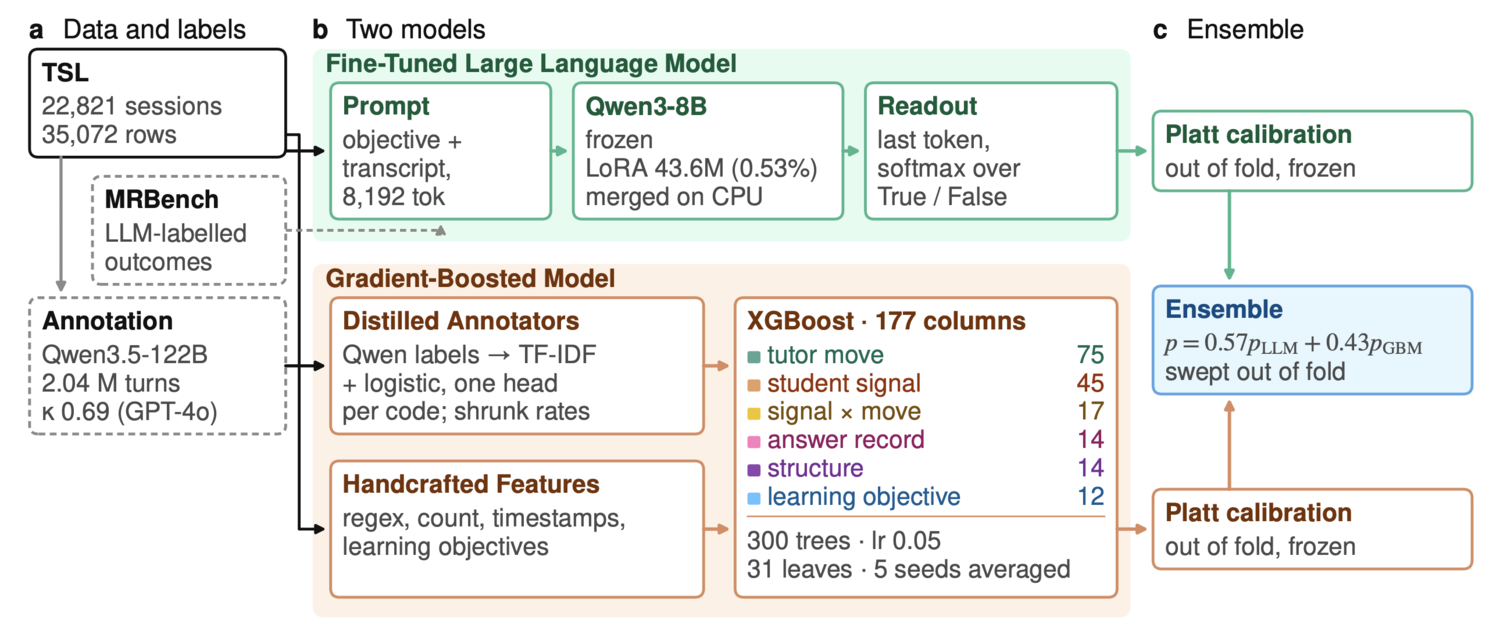
The most consistent signal was not a tutor move, it was a student explaining their thinking. Students who did more of the talking and reasoned out loud were more likely to answer the quiz question correctly, while frequent short answers were associated with lower success. Other useful student signals were showing confusion or correcting themselves. MPWARE found that tutor features added a smaller boost to predictions than student features, and appleswim found that how much a tutor move mattered depended on how the student responded to it. Team Chicken modeled student behavior and student-tutor interaction, but had no features describing tutor moves alone.
Knowing the student's level of understanding going into a session would help isolate effective tutor moves. Several participants cautioned that tutors adjust to how a student is doing, asking more questions and talking more when a student is struggling. That makes it hard to tell whether a tutor move changes how well a student does, or simply reflects how the student was already doing.
The models were better at ranking students than at predicting exact odds. On unseen data providers, appleswim's and MPWARE's models were better at flagging which students were most likely to be struggling than they were at calibrating the exact probability of correctness. Their probabilities of correctness stayed anchored near the training data's 70% success rate, suggesting that more diverse training data capturing multiple tutoring providers is needed to create a generalizable model.
Winner Overview
| Place | Team | Prize | Log loss | AUROC |
|---|---|---|---|---|
| 1st Place | appleswim (LCBOB and KayX) | $15,000 | 0.592 | 0.647 |
| 2nd Place | MPWARE | $10,000 | 0.595 | 0.642 |
| 3rd Place | Team Chicken (chicken and nicholaschuawork) | $7,000 | 0.593 | 0.647 |
All winning solution code and reports can be found in the winners repository on GitHub. All solutions are licensed under the open-source MIT license.
Meet the Winners
appleswim
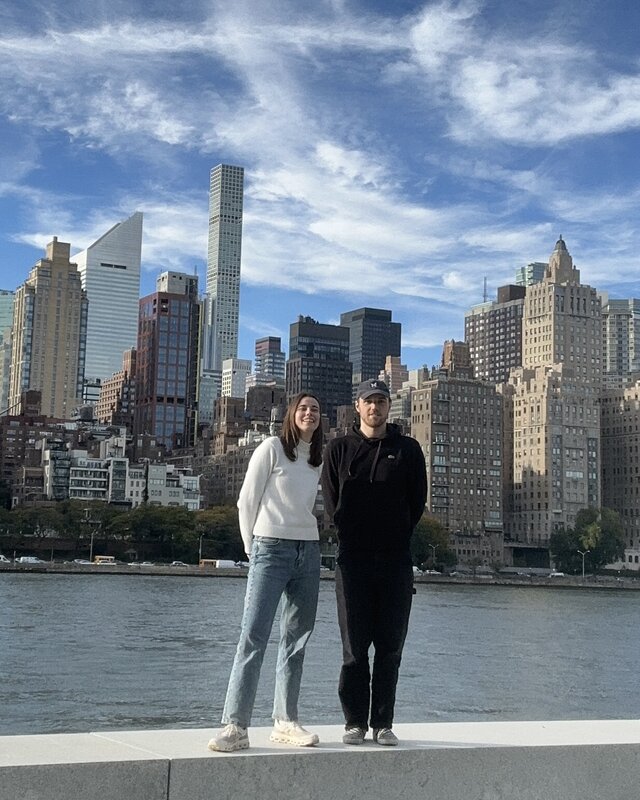
Team members: Tereza Blazkova and Louis Boucherie
Place: 1st Place
Prize: $15,000
Hometowns: Prague, Czech Republic; Paris, France
Social media: tereza-blazkova.github.io, louisboucherie.com
Solution write-up: link
Background:
Tereza Blazkova: PhD student at the University of Copenhagen (Center for Social Data Science) and currently a visiting researcher at Cornell University. I do research on responsible AI in education, focusing on algorithms that predict student success and studying them from the perspective of algorithmic fairness and participatory AI.
Louis Boucherie: Postdoctoral researcher at Columbia University (Department of Biomedical Informatics) and the University of Copenhagen (Center for Social Data Science). I do research in computational social science, combining large-scale human behavior datasets with statistical and machine learning methods.
What motivated you to compete in this challenge?
We joined the challenge because, with the increasing use of AI in education, there is a need to understand current practices, so that we know how and where AI is beneficial and how to evaluate its use.
The dataset was also a big part of the motivation: a unique prediction task, and orders of magnitude larger than anything that exists in the literature.
What kept us going was the difficulty of the challenge, as achieving generalizability was hard. Seeing both our own progress and others' improvements was rewarding and kept the experience fun. The organization was also a big help, and the organizers' responses in the discussion forum made the whole experience smoother and more engaging.
Summary of approach:
Our model is an ensemble of a fine-tuned LLM and an XGBoost model. The LLM is fine-tuned on Third Space Learning and MRBench.
The XGBoost features cover tutor moves, student signals, their interactions, transcript structure, in-session answer correctness, and features derived from the learning objectives. The tutor moves build on the National Tutoring Observatory's (NTO) taxonomy, which we extend with further tutor moves and student signals drawn from tutor interviews and data exploration. By student signals we mean the features that capture how a student responds and participates during tutoring, from confusion and frustration to self-correction and help-seeking.
Check out appleswim's full submission in the challenge winners repository.
MPWARE

Name: Eric Ben Hamou
Place: 2nd Place
Prize: $10,000
Hometown: Paris, France
Username: MPWARE
Solution write-up: link
Background:
I'm a senior software engineer and data scientist working on product engineering and applied machine learning. In my spare time I take part in machine-learning competitions, mostly NLP (transformer and LLM fine-tuning) and Computer Vision.
What motivated you to compete in this challenge?
What attracted me to Trace the Ace was the combination of an interesting machine learning problem and a meaningful educational application.
Predicting whether a student will answer a question correctly from a tutoring conversation is challenging. The useful information is not necessarily contained in a particular sentence or keyword. It may emerge from how a student explains an answer, responds to a hint, corrects a mistake, or participates throughout the lesson.
I was also interested in the generalization challenge. I wanted to explore whether a model could recognize meaningful signs of student understanding across different learning objectives, rather than simply learning which questions or concepts tended to be easy or difficult in the training data.
This made the competition an opportunity to explore both modern language models and more interpretable approaches to educational prediction.
Summary of approach:
My approach combines three complementary ways of analyzing tutoring sessions: statistical text features, structured dialogue features, and fine-tuned language models.
First, I built a lightweight baseline using TF-IDF, logistic regression, and LightGBM to capture textual and session-level patterns. I then developed a richer LightGBM model with features describing student explanations, self-corrections, tutor questions and hints, and how students respond to them.
In parallel, I fine-tuned three Qwen language models (4B, 8B, and 9B) using LoRA. These models analyze the tutoring conversation alongside the learning objective to predict whether the student will answer the subsequent assessment question correctly.
A key part of the approach was designing a validation strategy that tests generalization across different learning objectives, using semantic skill grouping to reduce overlap between training and validation.
Finally, I combined the complementary model predictions using a logistic-regression ensemble trained on out-of-fold predictions.
Check out MPWARE's full submission in the challenge winners repository.
Team Chicken
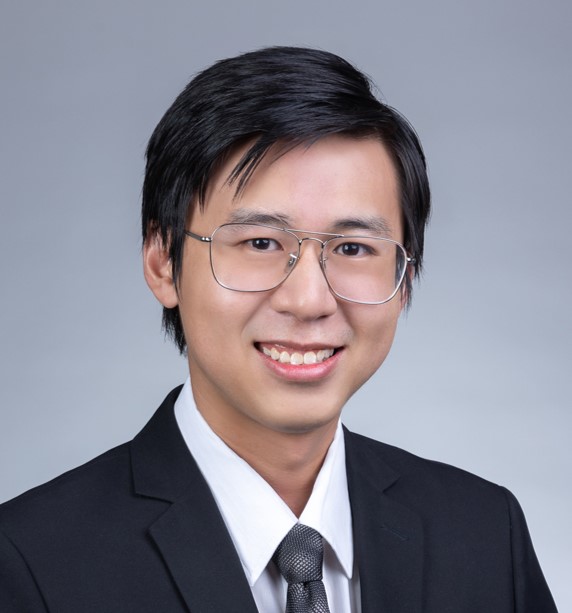
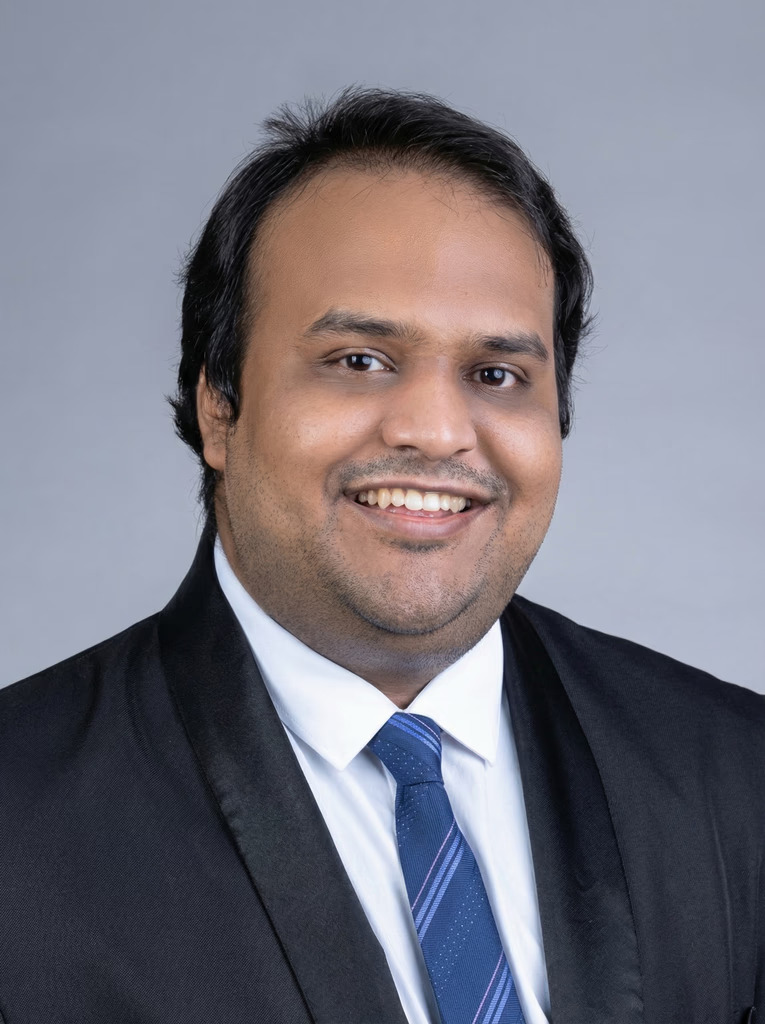
Team members: Nicholas Chua and Burhan Ul Tayyab
Place: 3rd Place
Prize: $7,000
Hometowns: Singapore; Hyderabad, Sindh, Pakistan
Usernames: chicken, nicholaschuawork
Social media: github.com/NCWork, github.com/BurhanUlTayyab
Solution write-up: link
Background:
Nicholas is the Head of AI at Kookree, with three years of experience in deep learning and computer vision. He graduated from the National University of Singapore with honours in Data Science and Analytics and published a research paper at WACV 2025.
Burhan is the co-founder and CTO of Kookree, where he leads the development of its vision-language model for real-time video understanding. His research focuses on domain adaptation and pattern recognition, with publications at WACV and NeurIPS. He has reviewed papers for NeurIPS, CVPR, ECCV, WACV, ICLR and AAAI.
Burhan placed first in the NeurIPS 2021 Visual Domain Adaptation Challenge and the A*STAR Manufacturing Challenge 2024, and won the MIT COVID-19 Challenge 2020. Before Kookree, he was AI Lead at Lauretta.io, where he built computer vision systems deployed at HTX and Changi Airport and developed airport security screening technology under a U.S. DHS/TSA contract.
What motivated you to compete in this challenge?
We were interested in whether language models could infer what a student had learned from a tutoring conversation. A student may arrive at an answer after several hints, give a partially correct response, or acknowledge an explanation without demonstrating understanding. Distinguishing these cases makes this a challenging and useful prediction problem.
The challenge gave us an opportunity to apply our machine learning experience to education and explore how contextual language understanding could be combined with explicit evidence of student knowledge. We also wanted an approach that could transfer across learning objectives rather than depend too heavily on the objectives seen during training.
Summary of approach:
Our solution combines a direct language-model prediction with a separate prediction built from student-answer evidence and interaction features. Both paths estimate the probability of later quiz success.
Direct prediction with Qwen3.5-9B. We fine-tuned Qwen3.5-9B using LoRA, which adapts the model by training a small set of additional parameters. It receives the learning objective and the last 3,400 tokens of the tutoring conversation, allowing it to interpret answers, hints and the surrounding dialogue in context.
Response assessment and shared mathematics skills. We also fine-tuned Qwen3.5-2B on manually labelled student replies from 1,000 transcripts. This model classifies replies as correct, incorrect or impossible to assess. Pretrained MiniLM embeddings map tutor-student exchanges and learning objectives to a shared vocabulary of 229 Common Core mathematics standards. Combining these mappings with the response assessments yields seven skill-based measurements. This representation is intended to reduce overfitting to particular learning objectives and support generalisation to unseen objectives.
Feature-based prediction. We combined the seven skill measurements with 27 interaction measurements, including how much the student wrote and how often they gave short replies. A logistic regression model uses these 34 features to produce an evidence-based prediction of quiz success.
Calibration and final blend. We calibrated the direct model score and combined the two paths in log-odds space, assigning 70% weight to Qwen3.5-9B and 30% to logistic regression. A final adjustment around the baseline log-odds produces the submitted probability. If the direct model prediction is unavailable, the feature model provides the fallback.
Check out Team Chicken's full submission in the challenge winners repository.
Thanks to all the challenge participants and to our winners! Prizes generously supplied by our friends at the National Tutoring Observatory. Thank you to Third Space Learning and Eedi for providing the data.